SPS Software vs. Simscape Electrical
Will 2026a be the beginning of a new era?
The release of MATLAB/Simulink 2026a will certainly mark a key milestone for many electrical engineers, not because of the release of major new features, but because of the discontinuation of the Specialized Power Systems (SPS) blockset.
As anticipated by rumors, since 2026a, MathWorks has completely deprecated and removed the Specialized Power Systems library from its standard distribution and has transferred commercialization and development rights to OPAL-RT Technologies. Moving forward, SPS will hence be maintained and sold exclusively by OPAL-RT as a separate software package, rebranded as SPS Software. Concurrently, MathWorks is actively transitioning its user base to its native Simscape Electrical blockset, which relies on an entirely different mathematical and architectural paradigm.
This transition fundamentally alters the toolchain landscape. Engineering organizations, academic institutions, and utilities will inevitably have to choose between the complex process of converting their simulation models to Simscape Electrical or the equally demanding option of procuring an SPS Software license from OPAL-RT to maintain continuity with existing models.
With the latest release of the ACG SDK, imperix software already supports both environments. Additionally, MathWorks’ variant of SPS remains available with all MATLAB releases up to 2025b. Our users are thus not forced to choose immediately. However, for those who wish to use the 2026a or subsequent releases, a critical decision will eventually have to be made.
In this context, this article aims to provide a comprehensive comparison of the two environments and offer a technical justification for toolchain selection. It also provides advice for imperix customers on migrating “back” from SPS to native Simscape Electrical while maintaining reasonable simulation performance.
Two fundamentally different worlds
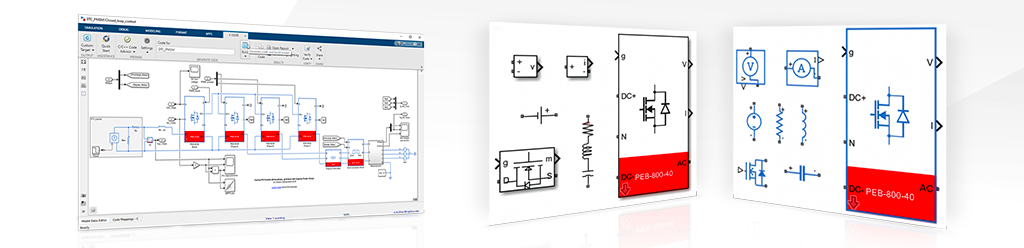
Specialized Power Systems and Simscape Electrical serve the same purpose, namely the simulation of electrical systems. However, SPS uses black, square ports, while Simscape Electrical uses blue, circular ports. This immediately reflects their difference and mathematical incompatibility: they solve different sets of equations using different numerical methods.
Specialized Power Systems (now SPS Software)
SPS is based on a modeling principle that uses directional input-output signals. With that approach, the electrical circuit is formulated as a large, monolithic system of state-space Ordinary Differential Equations (ODEs). The resulting mathematical environment is centrally managed by the powergui block, which offers three distinct solver modes:
- Continuous mode: It offers high waveform fidelity, notably in the presence of switching transients, but the simulation speed is heavily bottlenecked by zero-crossing detection stalls and stiff differential singularities.
- Discrete mode: It efficiently processes massive networks using robust fixed-step solvers to avoid continuous stalls. However, the fixed time step introduces highly penalizing time-quantization errors in the duty cycle unless it is chosen very small.
- Phasor mode: The key feature of SPS. Instead of solving differential equations for instantaneous values, it solves algebraic equations for complex phasors (magnitude and angle) at a fundamental frequency (typically 50Hz or 60Hz). This provides exponential speed acceleration for utility-scale applications.
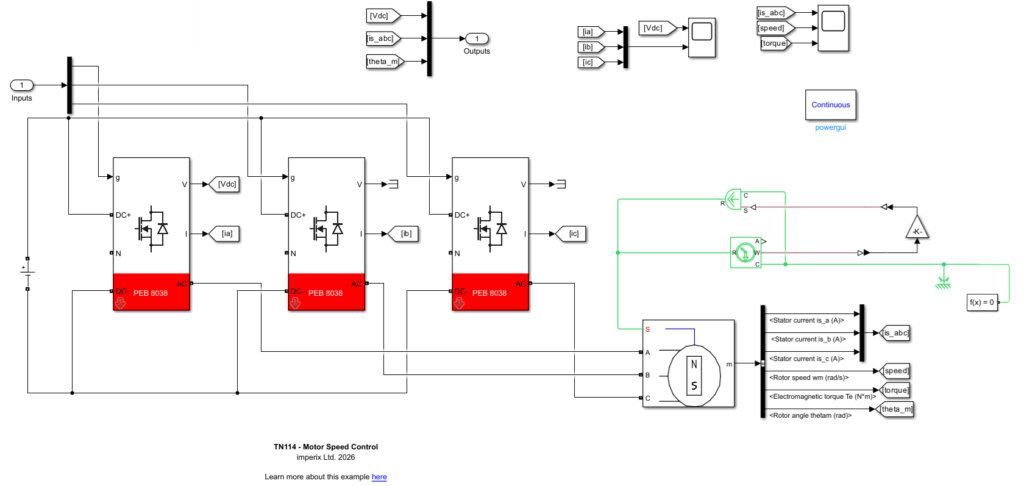
Thanks to this wide range of capabilities, the Specialized Power Systems toolbox is widely used across a broad spectrum of applications, for different reasons:
- For power systems research characterized by a large number of state variables (often encompassing thousands of nodes/buses) and relatively slow system dynamics, SPS is the undisputed leader. Also, as the state-space and nodal admittance solvers scale very well with large grids, handling load flows and hours of grid simulation is possible without numerical instability.
- For power electronics, because it relies heavily on ideal and piecewise-linear switches, the solver easily bypasses the sub-microsecond switching transients and their associated non-linearities. As a result, while not as fast as specialized software such as PLECS, SPS provides attractive simulation speed.
Simscape Electrical
Simscape Electrical is part of MathWorks’ Simscape foundation, offering multiphysics integration across the thermal, mechanical, magnetic, hydraulic, and pneumatic domains. It employs bidirectional signals between blocks, representing physical energy exchanges (principle of power conservation) rather than directional signals.
The provided models include parasitic effects (snubbers, internal resistances, junction capacitances) by default, notably to ensure numerical solvability. This introduces very fast time constants alongside slow ones, making virtually all models inherently stiff and requiring implicit solvers such as ode23t or ode15s (which compute the Jacobian matrix and perform Newton iterations at every time step).
Unlike SPS, which solves a centralized set of ODEs, Simscape Electrical solves multiple sets of implicit Differential-Algebraic Equations (DAEs). This increased complexity results in significantly longer simulation times, which is the major drawback of Simscape Electrical versus SPS. However, whenever a discrete-time simulation is acceptable, MathWorks’s so-called Partitioning Solver offers attractive performance improvements by automatically partitioning the large system matrix into multiple smaller matrices, which nearly compensates for the added complexity.
As a result, given its strengths and weaknesses, Simscape Electrical performs quite differently as a function of the application:
- For power electronics, Simscape Electrical enables the incorporation of complex semiconductor physics and detailed switching dynamics into the model. It also allows for seamless multi-domain integration. Provided that a good balance is found between accuracy and simulation speed, the software can be highly competitive.
- For power systems, Simscape Electrical is significantly less attractive than SPS. With large grids, such as the IEEE 118-bus system, the implicit DAE solver can suffer from serious “jamming”, potentially to the point of completely stalling the simulation.
A fracture beyond the mathematical architecture
The difference between Simscape Electrical and SPS Software doesn’t stop at their mathematical architecture. Their comparison reveals a real divide between two user groups who share little to no common habits in their use of computer simulation.
Usage- and feature-oriented differences
In SPS and Simscape Electrical, key blocks are parametrized using fundamentally different approaches. This hinders direct functional comparisons, and a non-trivial “translation” effort is required to migrate from one environment to the other.
| SPS Software | Simscape Electrical | |
| Machine models | Parameterized natively in Per-Unit (pu) | Parameterized in physical SI units |
| Transformers | Use pre-packaged system-level blocks | Use single-phase magnetic primitives |
| Power semiconductors | Use ideal or piecewise linear models | Use detailed, physics-based non-linear models |
| Transmission lines | Feature dedicated Bergeron blocks | Traditionally rely on lumped RLC elements |
| Grounding | Circuits can “float” without mathematical penalty | Floating circuits cause “singular matrix” crashes |
The way users are expected to interact with the simulation also diverges significantly: mostly through the powergui in SPS, and exclusively programmatically in Simscape Electrical. This disparity not only suggests but also necessitates fundamentally different workflows.
| SPS Software | Simscape Electrical | |
| Load flow | Automatically calculated from the powergui | Relies on generic Simulink.op searches |
| FFT analysis | Supported by an FFT Analyzer inside the powergui | Must be implemented programmatically (MATLAB command) |
Support for real-time (HIL) simulation
Beyond computer simulation, the fracture is also likely to deepen for those interested in Hardware-In-the-Loop (HIL) simulation. On the one hand, by taking over SPS maintenance, OPAL-RT shows a clear intent to further leverage SPS’s capabilities for the company’s own products. This potentially also reveals some dependence on the library, as eHS, ARTERMIS, and SSN were all originally designed to work with SPS. For OPAL-RT users, the vertical integration of SPS may thus offer promising prospects for further technical synergies, notably in FPGA-based real-time simulation.
On the other hand, MathWorks apparently favors the Simscape-to-VHDL workflow and relies on the Simscape HDL Workflow Advisor to support FPGA-based real-time simulation (e.g., on Speedgoat target hardware). While potentially more flexible, this approach required a (re)synthesis for each model build-up, which can take several tens of minutes per cycle.
Similarly, dSPACE seems to be taking the path of using newer extraction workflows from Simscape Electrical and favoring the company’s own Electrical Power Systems Simulation (EPSS) package. In parallel, the company is pointing to MathWorks’ spsConversionAssistant, which clearly indicates an intent to move its users away from SPS.
Given the situation, a possible outcome is that the entire industry splits into two separate, incompatible worlds, despite the apparent uniqueness of the MATLAB/Simulink environment. Power systems engineers and OPAL-RT users may end up with increased dependence on SPS, while others may already have turned their backs on it.
Migrating from SPS to Simscape Electrical
Porting models to Simscape Electrical
MathWorks provides the spsConversionAssistant to parse an existing SPS model and automatically map its components to their Simscape Electrical equivalents. The tool generates a new model and an HTML report categorizing the conversion issues. Unfortunately, in practice, users report that the assistant frequently fails to convert more than half the blocks, or generates so many warnings and errors that addressing them one by one takes as much time as re-drawing the entire model manually.
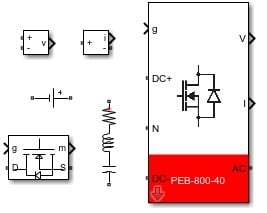
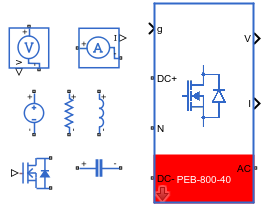
For imperix users, the situation is fortunately less critical, since two equivalent blocksets are available, one for each environment (see PN150). This permits migration by simply replacing the main imperix blocks (power modules, sensors, etc.) with their equivalents and re-wiring the rest of the power stage. Additionally, for other elements, MathWorks’ Simscape Electrical Support Library for Power Systems generally provides satisfactory equivalents.
Re-optimizing for simulation speed
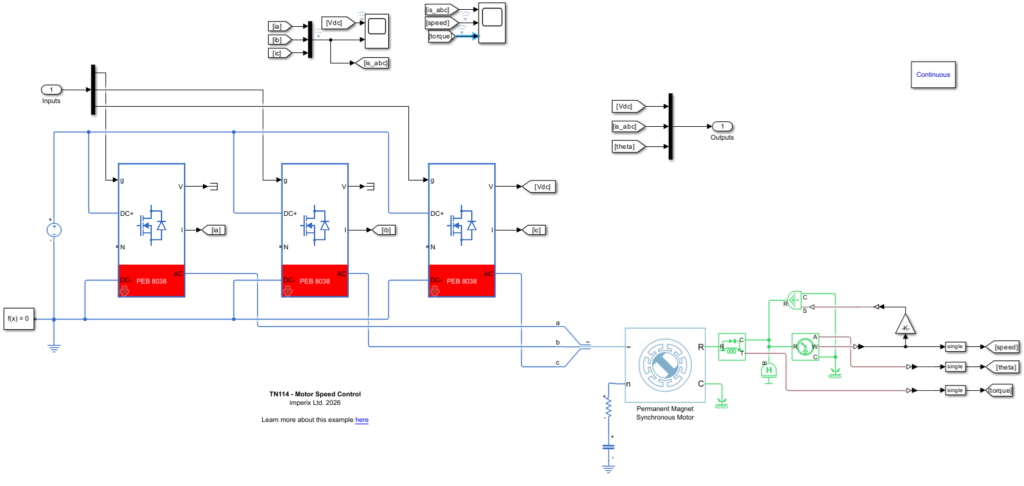
A recurring point of friction reported by engineers migrating from SPS to Simscape Electrical is a perceived degradation in simulation speed, particularly for power electronics. The root cause of these complaints lies in the fundamental difference in how these two libraries model semiconductors. In SPS, power switches are frequently modeled as ideal ones. However, in Simscape Electrical, users often default to the native N-Channel MOSFET block, which represents the highest level of fidelity available. In such a case, the simulation speed can easily degrade by a factor of 10x to 200x.
Here again, fortunately, the imperix PowerLib provides pre-configured model blocks that offer indirect guidance for selecting the right trade-off between accuracy and simulation speed. Furthermore, two levels of modeling detail are available, the simple one supporting both switching and averaged modeling approaches.
Ultimately, with an adequate solver configuration (see TNxxx), Simscape Electrical models can be run almost as fast as with SPS. While this doesn’t match the performance of specialized solutions such as PLECS, it doesn’t constitute a significant barrier to adoption either.
Conclusion
SPS Software: a solution for power systems
For about three decades, Specialized Power Systems (SPS) has dominated the electrical systems simulation market. Meanwhile, it has become a highly mature environment offering highly optimized tools for three-phase power systems and electrical networks. Thanks to this legacy, SPS offers capabilities that are clearly superior to the base Simscape Electrical environment, especially for large-scale AC or DC grids. For such demanding power systems applications, the performance gap, coupled with the difference in functionality, is quite significant.
Users who fall into this first category may, therefore, have little choice: SPS remains the way to go. Similarly, engineers already using OPAL-RT equipment will certainly be forced to remain within the SPS realm. That’s actually to their advantage, notably as it allows them to benefit from the ARTEMIS and SSN solvers, including for real-time simulation.
Among others, those unwilling or unable to rewrite their models will certainly find the path of least resistance in OPAL-RT’s SPS Software. Very pragmatically, any solution offering continuity may, in fact, constitute a critical lifeline. Although OPAL-RT is not particularly known for its broad support of MATLAB revisions, the company nonetheless promises 100% backward compatibility with older revisions and pledges continuous synchronization with future MATLAB releases.
That support, however, doesn’t come for free. Since SPS software isn’t a stand-in replacement for Simscape Electrical, users must still – and simultaneously! – maintain a separate commercial subscription for Simscape from MathWorks. This double licensing not only increases the total cost of ownership and creates dual-vendor dependence, but may also necessitate new procurement negotiations, notably for universities that previously relied on campus-wide licensing policies.
Simscape Electrical: a capable mainstream replacement
From another angle, the complete removal of SPS from MathWorks’ portfolio may simultaneously be seen as a definitive signal of their long-term development roadmap. MathWorks is clearly focusing on the high-fidelity simulation of mechatronic systems. As these systems incorporate increasingly faster dynamics and are rarely confined to a single physical domain, one might easily see a global trend toward increased stiffness, which MathWorks is only seeking to follow.
In this second context, namely that of small- to medium-sized, high-frequency, and multi-domain mechatronic systems, Simscape Electrical can be perfectly competitive with SPS, provided that the level of model fidelity is well aligned with the specific engineering objective (not too detailed!). Additionally, because Simscape Electrical is a first-party solution, it offers deeper, more robust API hooks into MathWorks’ advanced toolboxes, such as Simulink’s Control Design toolbox.
During its time within the MathWorks ecosystem, SPS was already a highly specialized and somewhat isolated solution. Now, as part of OPAL-RT’s solutions, this specialization may be even further increased. By committing to Simscape Electrical, organizations align themselves with a mainstream environment and avoid a permanent dependency on a secondary third-party software provider.
For imperix users, transitioning to native Simscape Electrical is now possible thanks to a dedicated blockset. However, there is no urgency in the matter. Once again, SPS remains fully usable through the 2025b release at no additional cost. By the time imperix’s support for that version is discontinued – hopefully in 10 years! – much may change in the computer simulation market for power electronics.