
The seven reasons why people choose us
Key differentiating factors of imperix solutions versus competing RCP/HIL vendors
At imperix, we are often asked about how our offer differentiates from other solutions for rapid control prototyping (RCP). Here below are seven reasons why our customers constistently choose our products, highlighting some key characteristics, but also why these characteristics matter.
1. Specialization
Within the Rapid Control Prototyping (RCP) landscape, we are the only company exclusively focused on control, as opposed to vendors offering products for both RCP and Hardware-in-the-Loop (HIL) applications. This positioning enables us to offer tailored products that solely serve as controllers (not simulators) but do so extremely well, without any design trade-off.
Unlike general-purpose RCP/HIL systems, our controllers cover a broad range of advanced functions as standard features. For instance, sampling is always simultaneous and synchronized with modulation, glitch-free variable-frequency switching is elementary, modifying a PWM phase in real-time is trivial, etc. Thanks to this approach, engineers only need to resort to implementing their own functions – or writing custom FPGA code – in extreme cases.
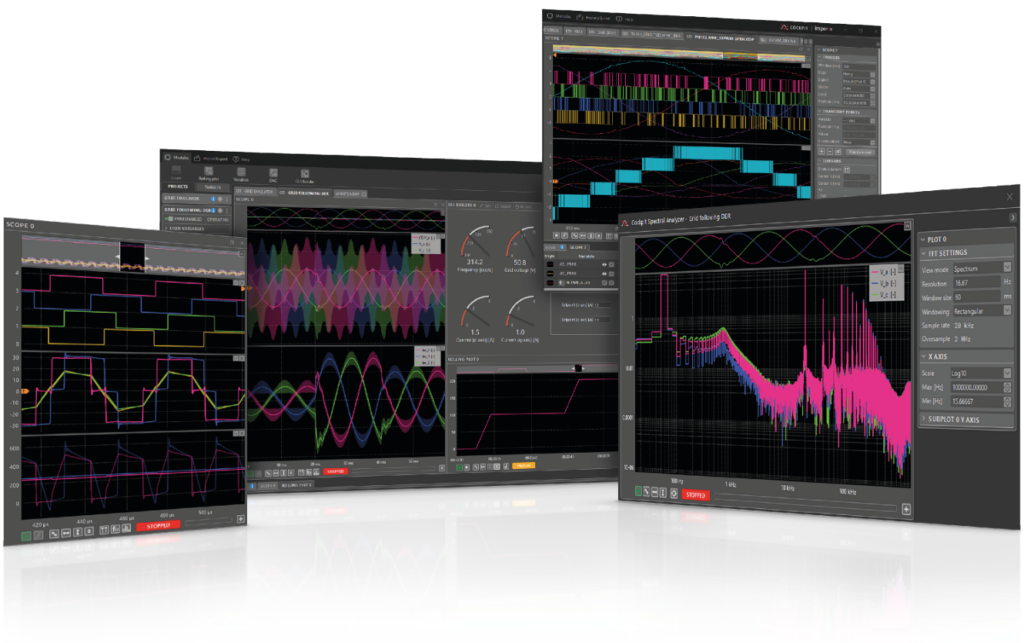
On the software side, Cockpit contains tools that are specifically targeted for control performance evaluation, during run time, without affecting the system’s operation. Apart from the basic capability to tune every variable without recompiling the code, it further offers a properly-triggered scoping module, a transient signal generator, FFT analysis options, signal statistics (incl. THD). etc. With the B-Box 4, these capabilities even extend beyond the control sampling frequency, thanks to oversampling.
Last but not least, in addition to our control solutions, we offer a comprehensive ecosystem of products that are designed specifically for laboratory-scale prototyping. Notably, our power modules ideally support the rapid assembly of power converters in the 1-100kW range, offering plug-&-play connectivity with our controllers as well as integrated gate drivers, protection logic and sensors.
2. Performance
Multi-purpose HIL/RCP boxes often rely on standard PC architectures, which limit the maximum achievable control rate to 50-100kHz due to excessive latency on the PCIe bus. Additionally, such unspecialized systems also frequently suffer from low PWM resolution and poor immunity to EMI and noise. Ultimately, these limitations become technological bottlenecks when working with wide-bandgap converters.
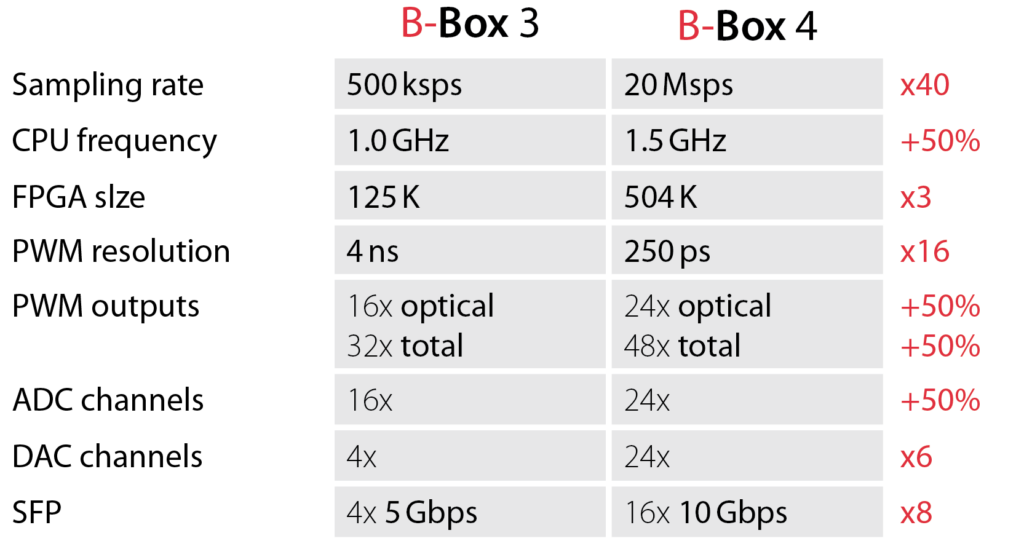
In our controllers, we address these limitations by utilizing advanced systems-on-chip that place the processor and the FPGA on the same silicon, minimizing transfer latency. Combined with a highly optimized bare-metal operating system, our architecture sustains hard real-time control loops that reach up to 500kHz on the CPU of the B-Box 4. Furthermore, the latter also happens to be the only RCP system to offer high-precision modulators, guaranteeing a resolution of ±250ps and an absolute precision of ±2ns, even accross multiple units.
Thanks to 20Msps 16bits ADCs, the B-Box 4 fully exploits the bandwidth of our newest range of modular sensors, which represent the backbone of the B-Box 4’s oversampling capability. At the analog hardware level, we implement high-end electronics and extensively leverage twisted pairs and shielding in order to maximize EMI rejection, particularly in the 1-20 MHz range (where this is most difficult but also critical), a detail often overlooked by conventional prototyping systems.
Overall, the core purpose of a prototyping system being to stay ahead of standard industrial capabilities, our controllers are designed with the performance headroom necessary to be truly future-proof. Commercialized since 2026, the B-Box 4 embodies what we do best and also represents a big leap forward for the RCP industry.
3. Safety
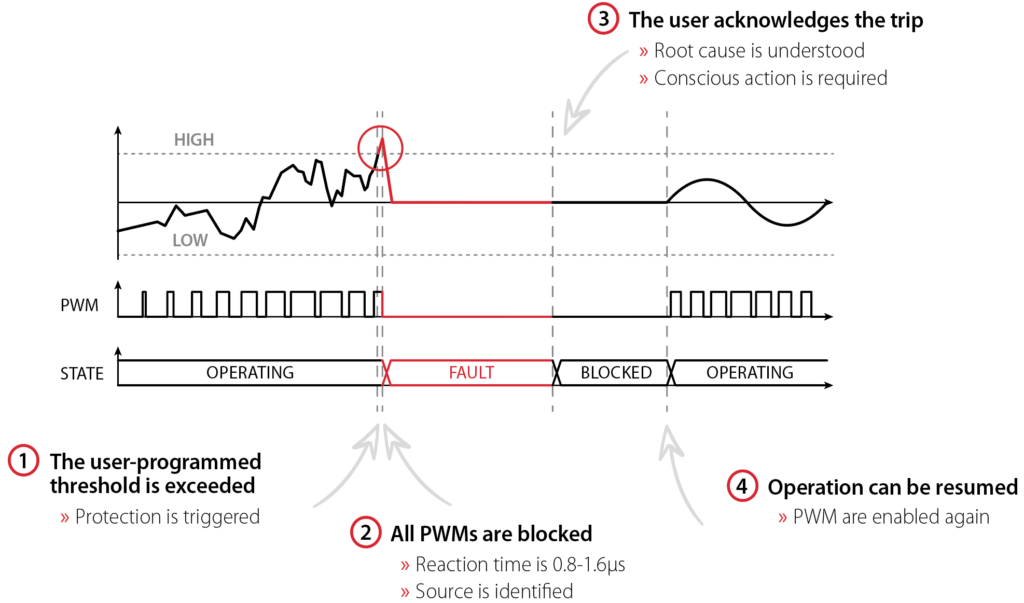
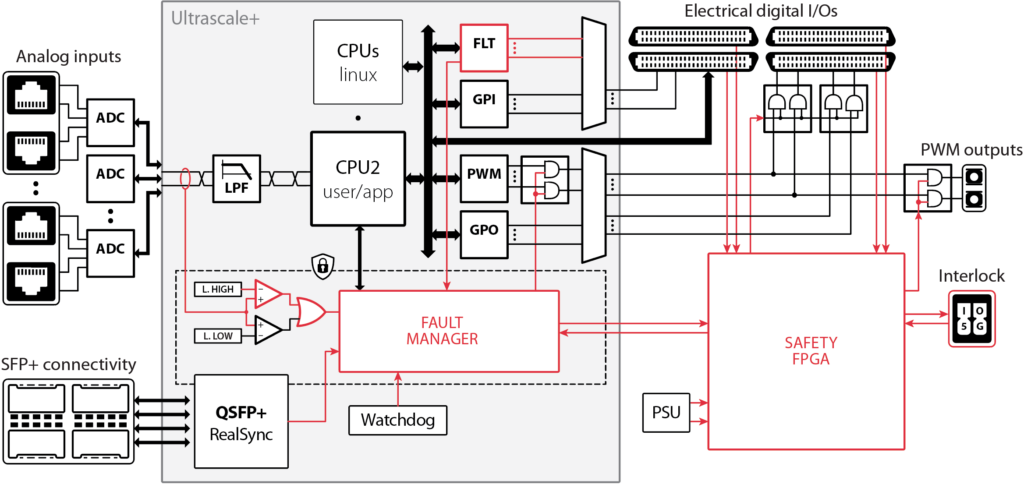
Experimental research requires uncompromising safety, especially when control algorithms are still undergoing validation. For that reason, our controllers integrate protections that are running entirely independently from the software. As a result, our controllers guarantee that the power stage always remains secure, even if the CPU experiences a software hang, the FPGA encounters an error, or a power supply fails.
Upon detection any hardware or software problem, all PWM outputs are instantly blocked. The fault source is also indicated by LEDs and log messages. This way, users can easily identify the root cause and re-initiate regular operatation once the trip has been acknowledged.
Our pulse-width modulators have been implemented and tested with utmost care, notably ensuring that a minimum dead time is always imposed and that a shoot-through condition is structurally impossible. This attention even extends to brief, but critical, conditions such as controller power-up or shutdown sequences, FPGA programming, or hardware failures, details generally neglected by general-purpose HIL/RCP boxes.
Finally, our controller can be easily interfaced with additional protection mechanisms, such as external fault flags, emergency stops, or inter-device interlocking. These signals are all handled by the hardware-level protection circuitry, as opposed to user-level mechanisms based on general-purpose digital I/Os.
4. Simplicity
With our equipment, plug-&-play isn’t just a vague promise. During experiments, everything is made to enable rapid assembly. Standardized RJ45 and optical cables ensure instant connections, while automated sensor identification accelerates the software configuration. Device programming can also be executed swiftly, by making just one click in the very same file that is used for computer simulations.
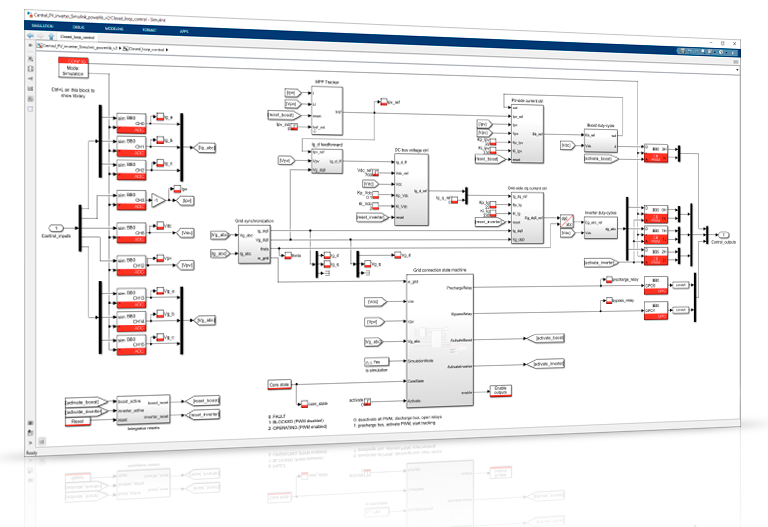
During the control design phase, the life of our users is also facilitated by blocksets and models that are easy to use, while accurately predicting the real-world behavior. This is achieved by a careful modeling of the sampling instants, processing delays, and control discretization, notably. Ultimately, this ensures that what happens in reality is also visible in simulation beforehand, which is essential for the pre-tuning of the control processes.
Once satisfactory simulation results are obtained, fully-automated code generation takes place, only requiring a single click to transform a Simulink/PLECS model into a readily-uploadable real-time executable. Thanks to our approach, the transition from computer simulation to real-time execution is made truly seamless and, therefore, truly simple.
Tools such as dSPACE ControlDesk are widely recognized as powerful but heavy. These are in fact designed for extensive measurement campaigns – manipulating thousands of parameters – rather than quick, performance-oriented, control evaluation and troubleshooting. With our solutions, everything is handled entirely within Simulink/PLECS. The accompanying Cockpit software is solely utilized for real-time monitoring and scenario generation, requiring no complex configuration and avoiding cumbersome model rebuilds.
5. Openness
Our products are software-agnostic and equally support MATLAB/Simulink, PLECS, and C++. Similarly, modeling libraries exist for Simscape Electrical, Specialized Power Systems and PLECS. This guarantees a flexible development experience, minimizing the risk of vendor lock-in. Furthermore, all provided application examples and simulation models are fully open-source, allowing researchers to dig into the underlying code and modify it upon their wishes, if needed.
While most power electronics operations can be executed effortlessly without FPGA programming, advanced users always retain complete, unrestricted access to program the device. This ensures the system remains adaptable to highly specialized or unconventional research demands.
Finally, researchers interested in microgrids can also leverage our TPI8032, which certainly stands as the the market’s most open, fully integrated programmable inverter. This ready-to-use system includes control, power, measurement, protection, and grid connection circuits, while allowing full customization down to the current control, modulation, and FPGA logic.
6. Cost-Effectiveness
Whenever experimental results are required, the construction of self-designed prototypes often constitutes the main alternative to using our products. In such a make-or-buy decision, our solutions represent an excellent choice by offering outstanding time savings. Financially, our products also prove to be highly competitive in the long run thanks to our attractive software licensing policy:
- Our volume discounts on software are gradually increased based on the total number of licenses acquired, regardless of the time of purchase. The more devices are owned, the cheaper they become.
- We apply a strict one-time purchase model with free upgrades, free support and no maintenance fees for the entire life of the products. As a result, our users always benefit from the best available tools. They also consistently find that the software evolves regularly and significantly, well beyond their initial expectations.
- Software licenses are only required by controllers that actually run a model within their CPU, i.e. master units. Slaves do not require a license. Porportionally, this reduces the cost of large control systems leveraging multiple units.
- FPGA programming is always absolutely free as we never charge for it. Furthermore, the B-Box 4 purposely embeds the largest AMD FPGA that can be programmed without a paid Vivado license, ensuring no hidden costs from third-party software either.
Overall, with a consistent price-per-channel across the portfolio, there is an optimally-priced Imperix controller for every budget and project scale. The B-Box micro, priced slightly above 5k€, represents the entry-level of the product range, which is complemented by the B-Box 3 and 4, priced at 12k€ and 18k€, respectively.
7. Support
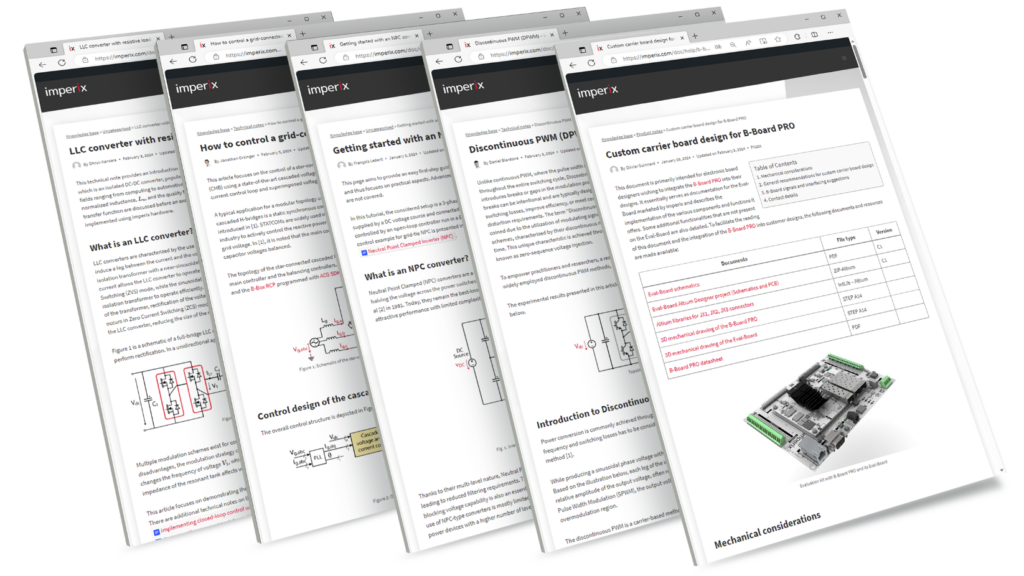
Imperix users benefit from an extensive and continuously updated library of online documentation comprizing application examples and step-by-step tutorials, systematically featuring downloadable open-source files.
Additionally, when complex challenges arise, they also have access to highly responsive technical assistance provided directly by the same engineers who designed the products they are using.