
Table of Contents
Power Hardware-In-the-Loop (PHIL) is a well-known method to validate the electrical behavior of a power device under test (DUT) under specific conditions without the need of the full-scale physical infrastructure. Instead, the environment surrounding the DUT is emulated by a combination of a simulator – running the system’s mathematical model – with a power amplifier that translates the simulation results into physical voltages (or currents) applied on the DUT’s terminals.
Although primarily designed for direct prototyping, imperix solutions are well suited to act as power amplifiers by running fast real-time voltage or current tracking algorithms, and can therefore be paired with third-party simulators to create PHIL testbenches.
This page covers the fundamentals of a typical PHIL setup, compares it against other validation methods and presents how custom PHIL setups can be built from imperix solutions.
Typical PHIL setup
A typical PHIL setup consists of two main parts:
- The device under test (DUT) is any physical device whose behavior must be validated from its electrical terminals. It can be purely passive or include a control unit.
- The emulation system that mimics the desired DUT’s environment using:
- a simulator that runs a mathematical model of the desired DUT’s surrounding environment in real time;
- a power amplifier that receives relevant simulation outputs from the simulator and applies them onto the DUT’s terminals.
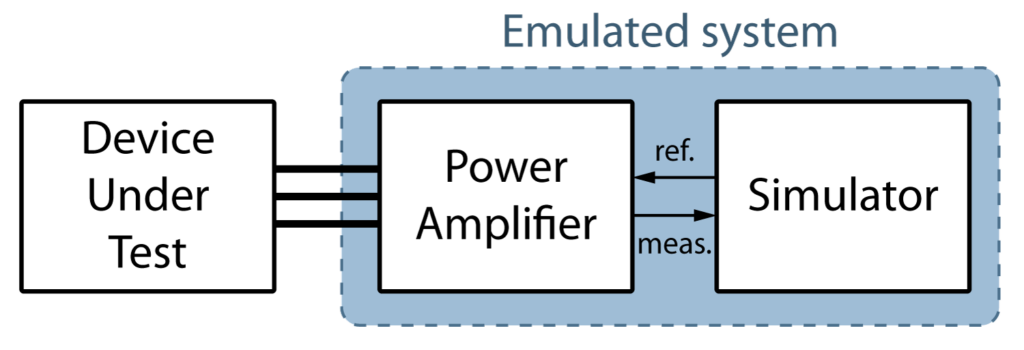
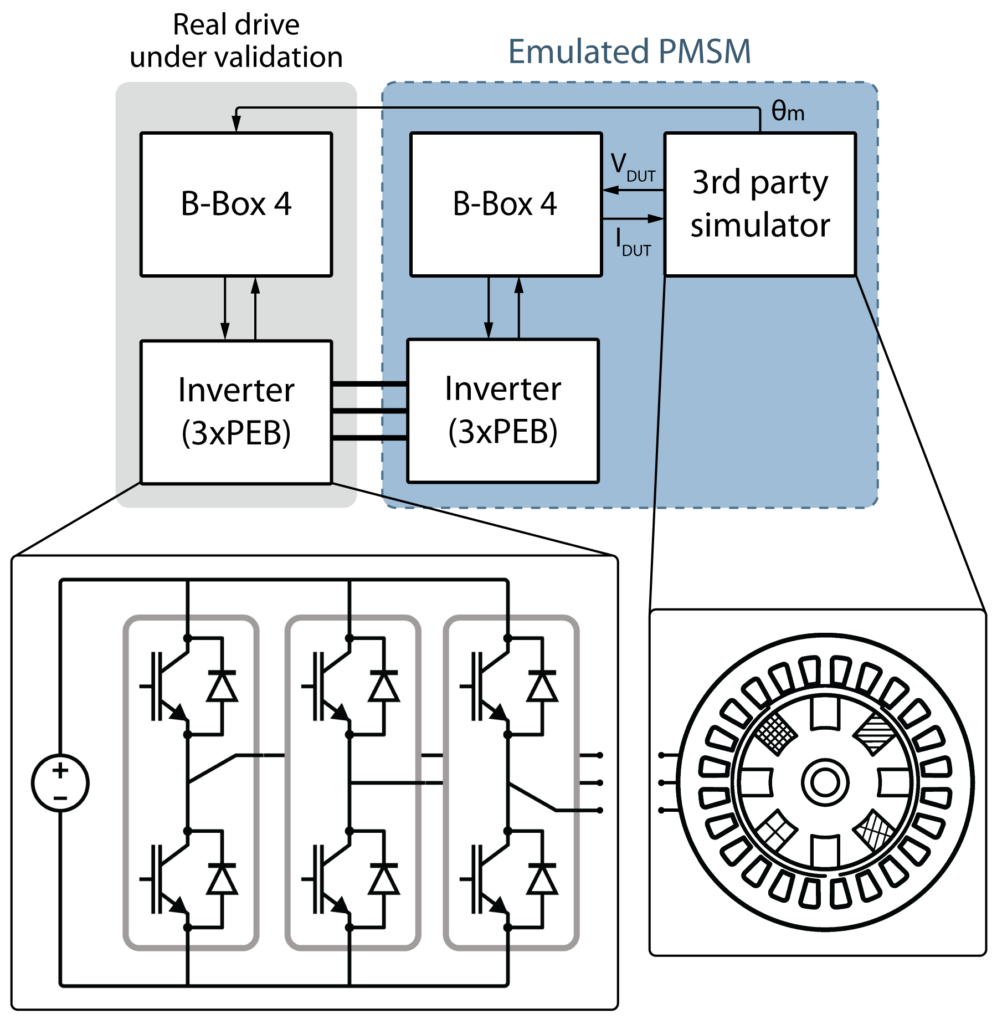
For instance, the PMSM example below demonstrates how a physical motor drive and its controller (DUT) are validated using an emulated Permanent Magnet Synchronous Machine (emulated system).
Comparison with other validation methods
PHIL is a validation approach that typically sits between Controller Hardware-In-the-Loop (CHIL) and real-condition testing. In the illustration below, the DUT has been explicitly divided into its control and power stages (the control side is omitted if the DUT is purely passive).
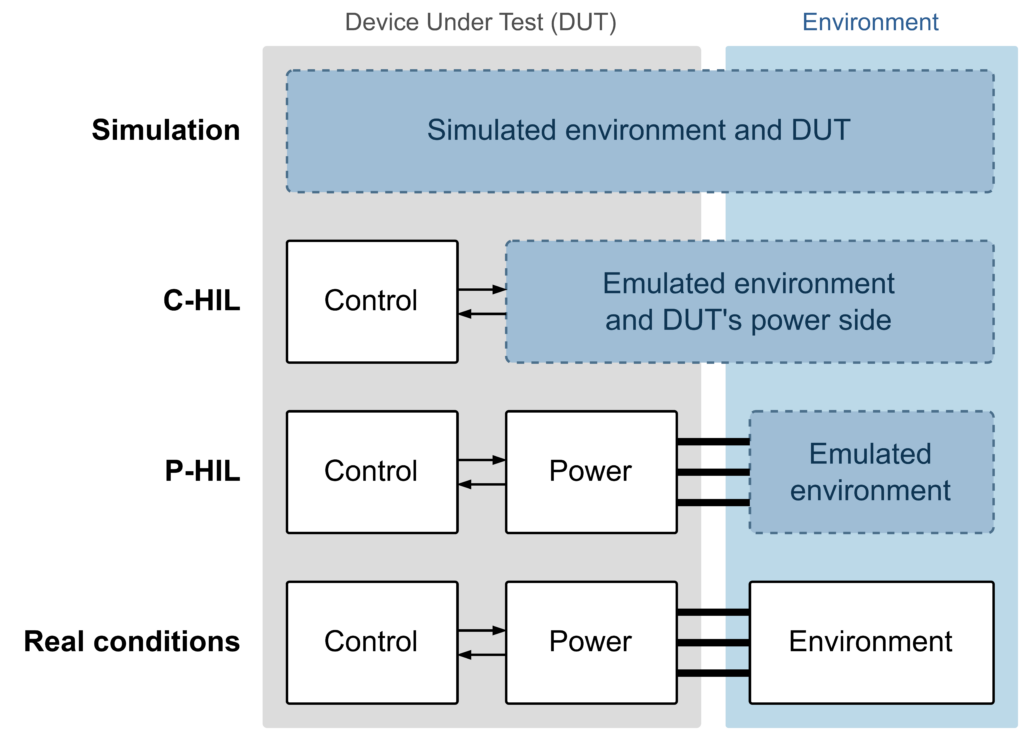
Unlike offline simulation and CHIL – which are discussed in detail in TN178 – PHIL extends the validation to the power stage. However, because the connection with the emulation setup operates in the power domain, a power amplifier is required, implying a non-negligible initial investment.
Compared to testing in real conditions, PHIL provides far greater flexibility – allowing the emulated environment to be adjusted on the fly via software – and enables rapid setup and fast iteration cycles. However, it cannot capture unmodeled physical behavior, which can only be observed under fully physical operating conditions. In this sense, PHIL capabilities are ultimately bounded by the fidelity of the underlying model.
Implementing a complete physical system, however, is often challenging and time-consuming, making the transition from PHIL (or any partial simulation) to full physical prototyping a significant step. Rapid prototyping solutions such as imperix help bridge this gap. By providing versatile, easy-to-use controllers and power hardware blocks, they enable fast and flexible prototyping directly under real operating conditions.
PHIL with imperix solutions
While primarily designed to accelerate lab validation, the flexibility of imperix devices makes them well-suited for PHIL applications. When paired with a third-party real-time simulator, imperix hardware easily acts as a power amplifier to create PHIL test benches.
Building a power amplifier
Creating a custom power amplification stage with imperix hardware can be achieved in different ways. A ready-to-use PHIL example is available for each approach.
Modular series
An imperix controller such as the B-Box 4 or B-Box 3 can be combined with power modules to create a fully customizable amplifier.
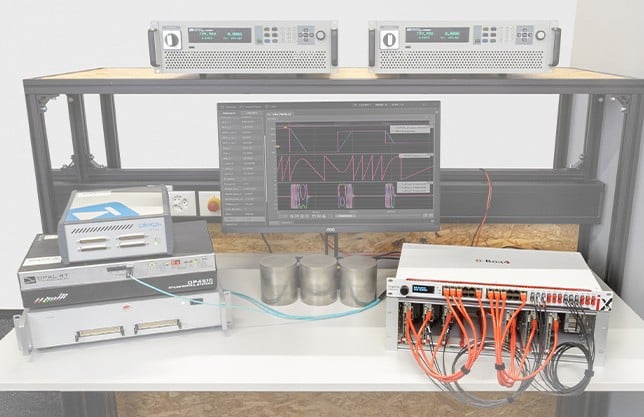
The motor emulation example with a B-Box 4 and power modules is available here.
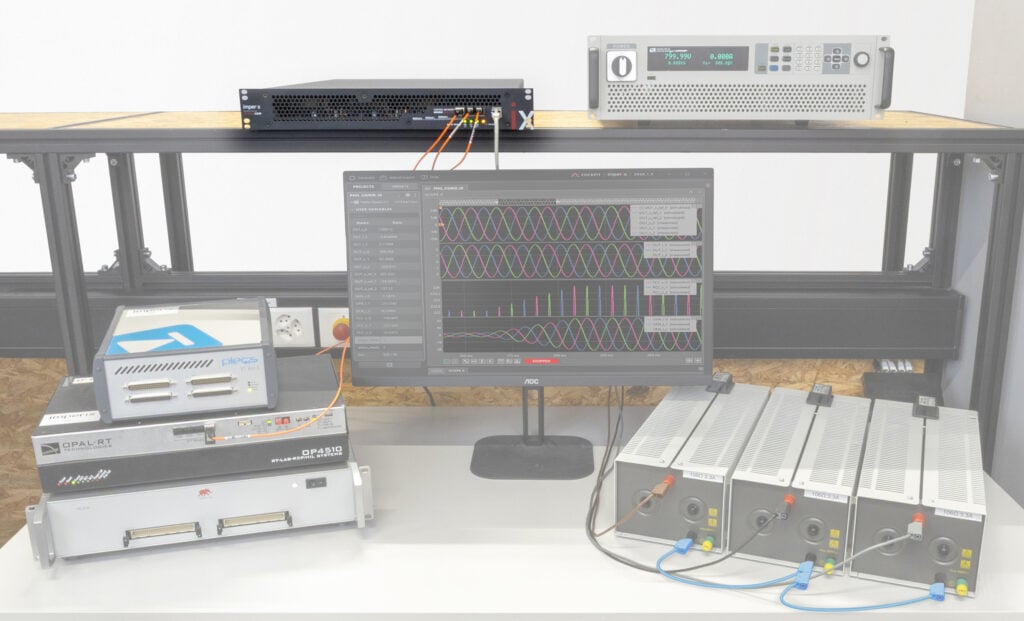
Combination with third-party simulators
Imperix controllers excel at control tasks, whereas dedicated third-party simulators are better optimized for real-time plant simulation. For high-performance simulation requirements, specialized third-party simulators equipped with dedicated hardware accelerators provide a more suitable solution.
Imperix devices are fully compatible with major simulator vendors, exchanging data either through analog connections or via digital communication over an SFP link. Many projects have successfully combined imperix hardware with platforms like OPAL-RT, Plexim, Typhoon HIL, RTDS, and others.

Analog and digital communication
Imperix supports both analog and digital communication links with third-party simulators.
Analog communication
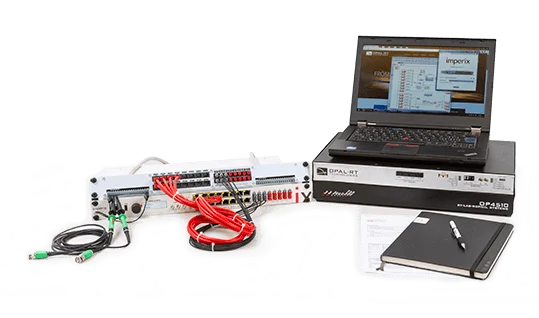
Thanks to the HIL interfaces, the analog interfaces of imperix controllers are compatible with the simulators’ electrical inputs and outputs.
SFP support
imperix provides ready-to-use drivers for our controllers to support the communication with external devices over SFP. All drivers, along with examples, can be found in the SFP thread.
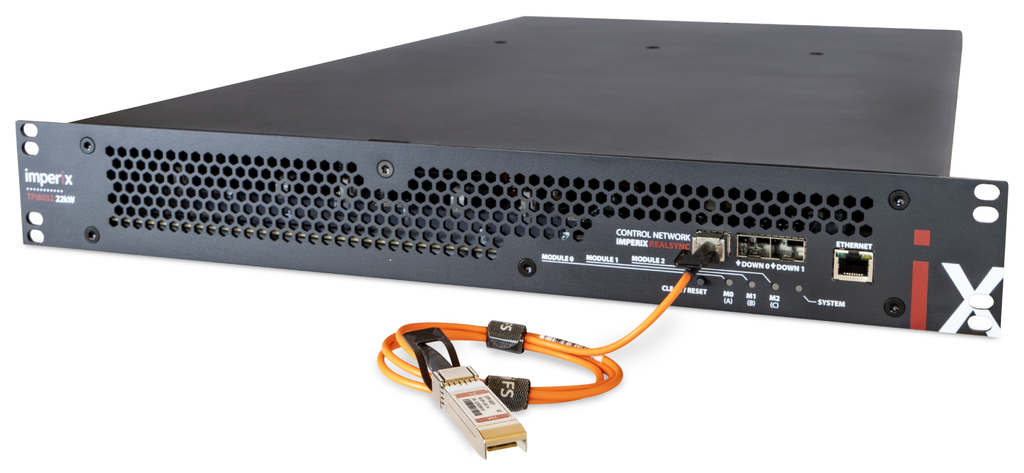
Although analog remains the conventional method for interconnecting devices, digital SFP links provide significant operational benefits for control setpoints and parameter exchange, such as single-cable simplicity regardless of signal count, immunity to electromagnetic interference (EMI), and the absence of calibration.
Ready-to-use examples
Two ready-to-use examples are provided, along with simulation files for OPAL-RT, Plexim and Typhoon.
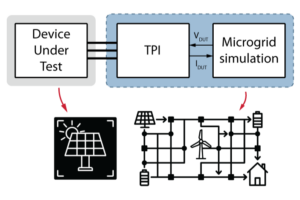
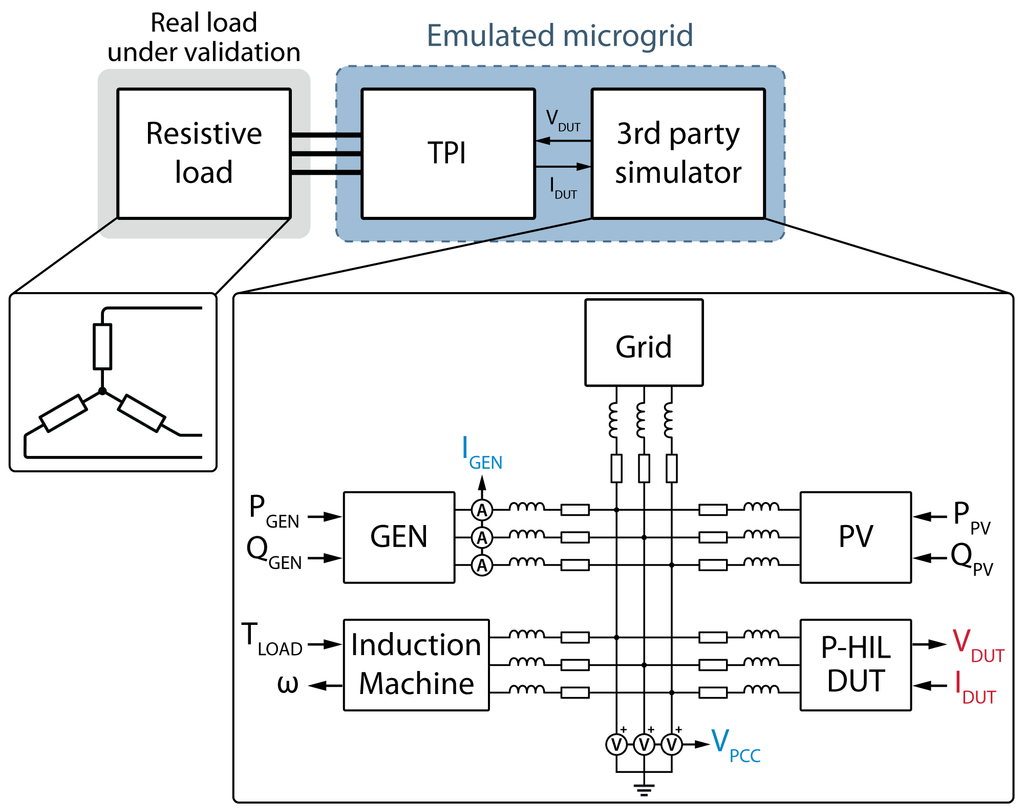
In Microgrid emulation for PHIL prototyping, the setup demonstrates the emulation of a microgrid, while a simple three-phase resistive load acts as a passive DUT. This example features the all-in-one programmable inverter.
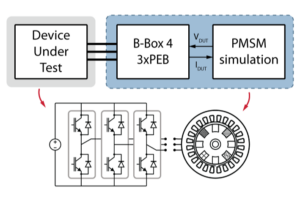
In the PHIL PMSM example, a more advanced configuration is featured, where a Permanent Magnet Synchronous Machine (PMSM) is emulated using a B-Box 4 and power modules to validate both the control algorithms and hardware of a drive.
 By François Ledent • June 25, 2024 • TN180