Table of Contents
This page presents a practical example of Aurora communication with Typhoon HIL simulators, specifically the HIL101, HIL404, HIL506, and HIL606. It provides a ready-to-use user application, along with an FPGA design specifically configured for interfacing Typhoon HIL simulators.
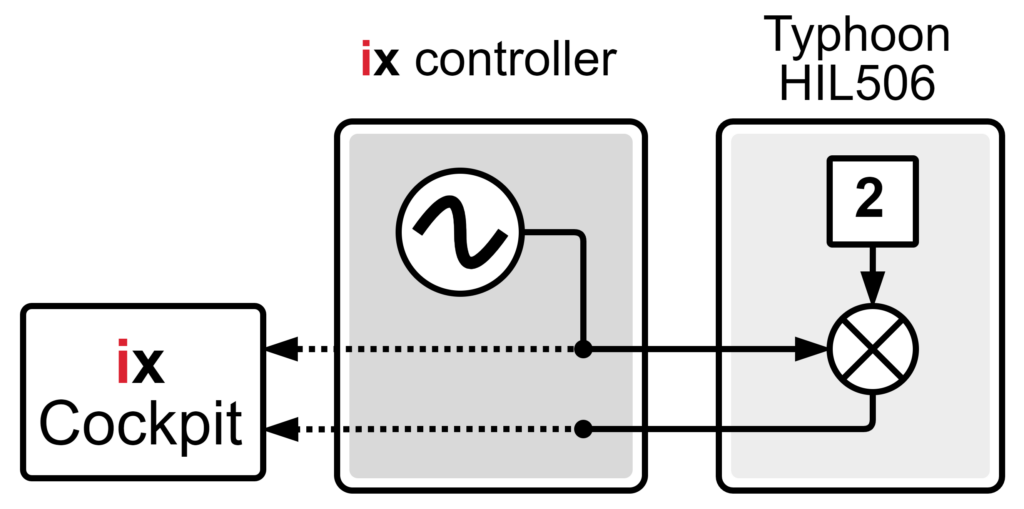
To demonstrate the setup, this page also includes pre-configured Typhoon Schematic Editor and HIL SCADA files implementing a simple loopback example. In this example, a three-phase sine wave is transmitted from the imperix controller, multiplied by two in the Typhoon HIL, and sent back to the controller.
For broader technical background, a general introduction to SFP communication with third-party devices is available. That page covers fundamental SFP considerations, describes the full communication chain, and provides guidance on implementing the imperix-side drivers.
Case study
This case study demonstrates a straightforward signal processing loop:
- The controller generates a three-phase sine wave and transmits it to the HIL506 via SFP.
- Upon receipt, the HIL506 applies a gain of two to the three signals – doubling the amplitude of the sine wave – and returns them to the controller, also via SFP.
- Finally, the original transmitted values and the received return signals are compared in real-time in Cockpit, showing the proper operation of the system.
Required software
- Vivado Design Suite (version 2023.2 is recommended)
The Xilinx installation page details the installation procedure. - FPGA sandbox template 3.10 or later.
Available on the FPGA download page. - C++ or ACG SDK version 2024.3 or later.
Available on the SDK download page.
On the third-party side, this project has been tested with a Typhoon HIL506, Typhoon HIL Control Center 2026.1 SP1.
Downloads
As explained in the setup overview, the SFP communication requires the three following software parts:
- The user application, running in the imperix controller’s CPU and provided as a Simulink or PLECS script.
- The FPGA bitstream, loaded in the imperix controller’s FPGA and provided as generation scripts.
- The third-party application, here running in the Typhoon simulator and provided as an archive containing the Typhoon Schematic Editor and Typhoon HIL SCADA files.
| User application | FPGA bitstream | HIL506 application |
| aurora_ix_template.slx aurora_ix_template.plecs | aurora_ix_typhoon_gen3_scripts.zip aurora_ix_typhoon_gen4_scripts.zip | aurora_ix_typhoon_files.zip |
Typhoon HIL application
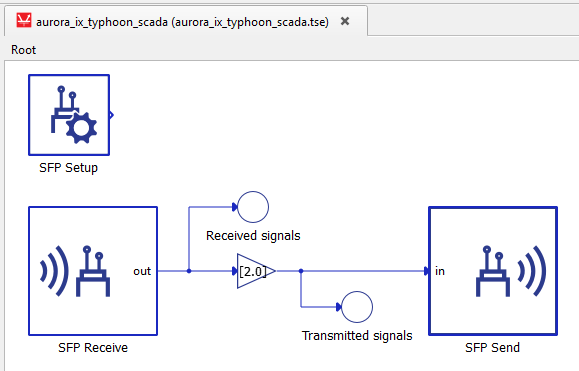
The application running in the HIL506 essentially contains an SFP Receive block to receive signals from the imperix controller via SFP, a gain of 2, and an SFP Send block to send the data back to the controller. It also contains the mandatory SFP Setup block to configure the SFP interface.
The SFP 1 port is selected in the SFP Receive and SFP Send blocks, and the header is disabled from the SFP Setup block. The values received through SFP are outputted by the SFP Receive block as a vector of three floating-point elements. The execution rate of all blocks is set to 2 us.
To build and load the model on the HIL506, open the aurora_ix_typhoon_sch_editor.tse design in the Schematic Editor and click the Compile and (re)load model in HIL SCADA icon. Once the compilation is finished, HIL SCADA will launch automatically and the code will be loaded onto the simulator.
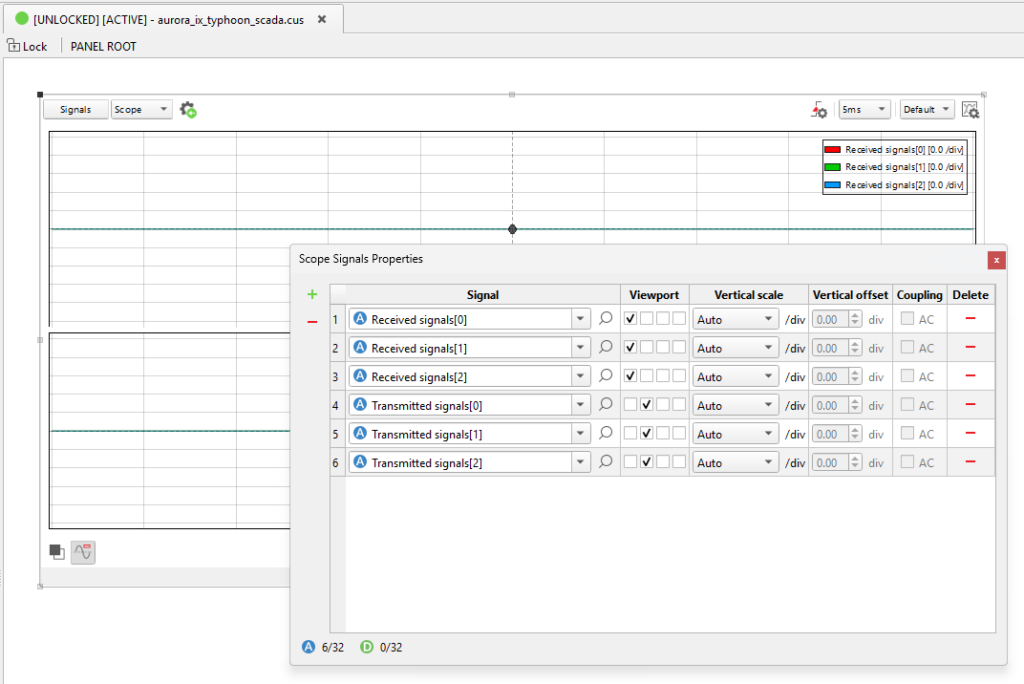
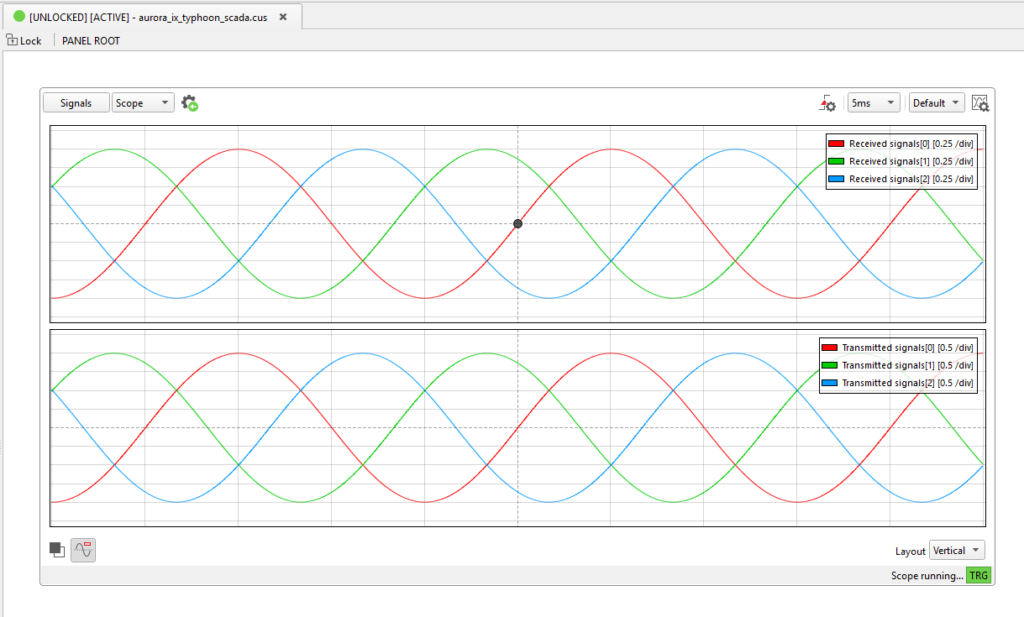
In HIL SCADA, open the provided aurora_ix_typhoon_hil_scada.cus panel and start the simulation. At this point, the code is running on the HIL506; data exchanged over SFP can then be monitored in the HIL SCADA scope (which will display only zeros if the imperix controller is not yet configured).
Communication chain
Overview
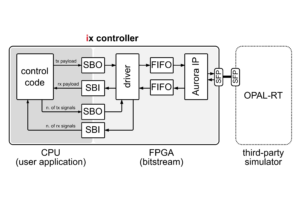
The overview of the communication chain is presented in the setup overview.
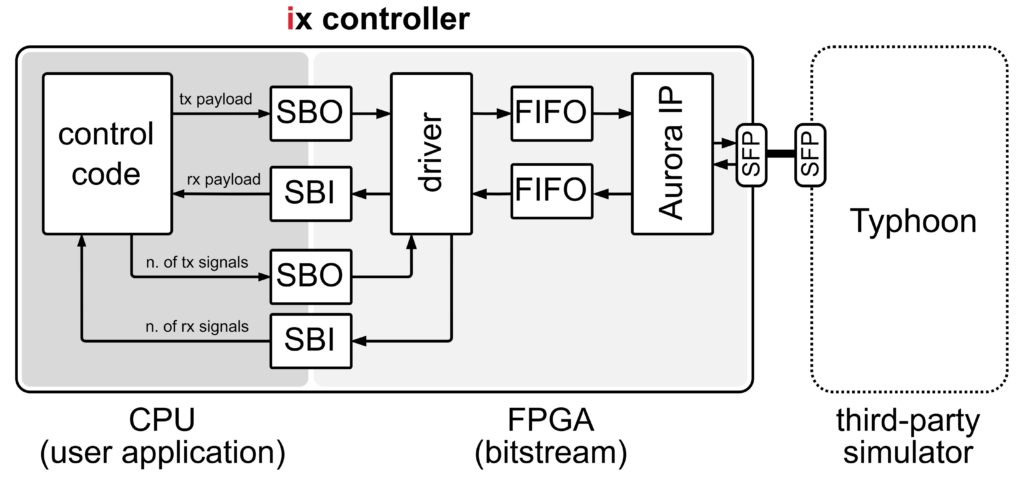
The main clock domain always runs at 250 MHz, while the frequency of the Aurora clock domain varies with the configuration of the Aurora IP. In this example, the frequency is 125 MHz with the configuration presented in the Aurora parameters section.
Vivado project
The Vivado project is provided in the form of generation scripts. As explained in the PN109 , the scripts automatically create and open the project illustrated below. The bitstream can be directly generated by simply pressing Generate Bitstream in the left navigation bar in the Vivado environment.
As provided in the source files, the driver supports the exchange of up to 50 signals in each direction and the Aurora communication is linked to the SFP 0 (UP) port of the imperix controller.
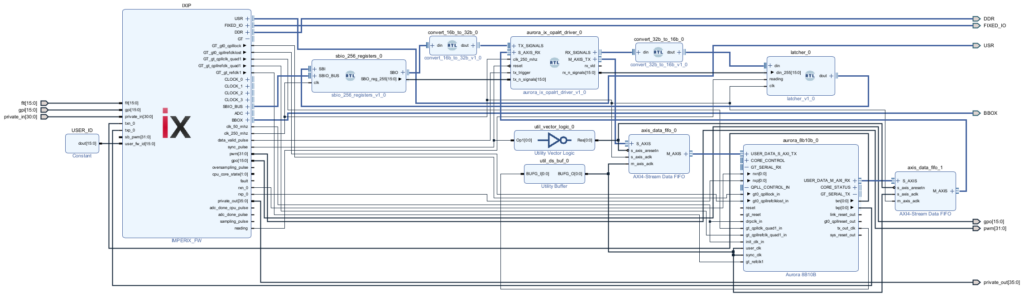
Once generated, the bitstream can be loaded onto the imperix controller using Cockpit. A reboot is required for the bitstream change to take effect.
Modules/IPs description
The Vivado project contains the following VHDL modules and IPs.
| Module name | Type | Description |
|---|---|---|
| sbio_256_registers | VHDL module | Instantiates and provides access to SBIO bus registers in the FPGA. More information is provided here. |
| convert_16b_to_32b | VHDL module | Converts the 16-bit words of the SBIO bus back into the 32-bit words of the payload. |
| aurora_ix_typhoon_driver | VHDL module | Custom driver provided by imperix to communicate with the Typhoon HIL simulators ; mainly acts as a parallel-to-serial transmitter and serial-to-parallel receiver. |
| convert_32b_to_16b | VHDL module | Converts the 32-bit words received from the simulator through the driver into 16-bit words compatible with the SBIO bus. |
| latcher | VHDL module | Ensures data coherency by preventing the update of the SBI registers while the CPU is reading. |
| AXI4-Stream Data FIFO | Vivado IP (Xilinx) | Handles the clock domain crossing between the main 250 MHz domain of the imperix firmware and the Aurora clock domain ; buffers the frame in the transmission direction. |
| Aurora 8B10B | Vivado IP (Xilinx) | Handles the Aurora communication and interfaces with the underlying hardware logic. |
| Utility Vector Logic | Vivado IP (Xilinx) | Converts the active-high reset signal from the sync_pulse into an active-low reset signal for the FIFOs. |
Aurora parameters
The included Aurora IP comes with the correct configuration pre-applied for interfacing with Typhoon HIL simulators. When creating a project from scratch, the Aurora IP must be configured in Vivado with the specific parameters listed below.
| Protocol | Aurora 8B10B | Interface | Framing |
| Line Width (Bytes) | 4 | Flow Control | None |
| Line Rate (Gbps) | 5 | Little Endian Support | No |
| Dataflow Mode | Duplex | CRC | No |
Any unspecified settings should remain at their default values.
Experimental validation
Physical setup
The physical setup is straightforward:
- Connect both devices to the network, so that they can be configured and monitored from the PC.
- Connect the imperix controller to the Typhoon simulator with an SFP cable. As provided, this example considers the port SFP 0 (UP) on the controller and SFP 1 on the simulator.
- Turn on both devices.
Software-side setup
To experimentally validate the system:
- Download the three software parts available in the downloads section.
- Build and load the Typhoon application on the simulator.
- Generate the bitstream for the imperix controller.
- Load the bitstream on the imperix controller via Cockpit.
- Build the user application template and launch it on the imperix controller via Cockpit.
- Use Cockpit to monitor the exchanged signals.
The whole system should now be running.
Real-time monitoring
Connect to the imperix controller with Cockpit. Add a scope in the project (from the Modules tab in the top bar) and drag-and-drop the variables of interest.
The exchanged signals can now be monitored in real-time in Cockpit. As expected, the amplitude of the transmitted signals is multiplied by two in the simulator.
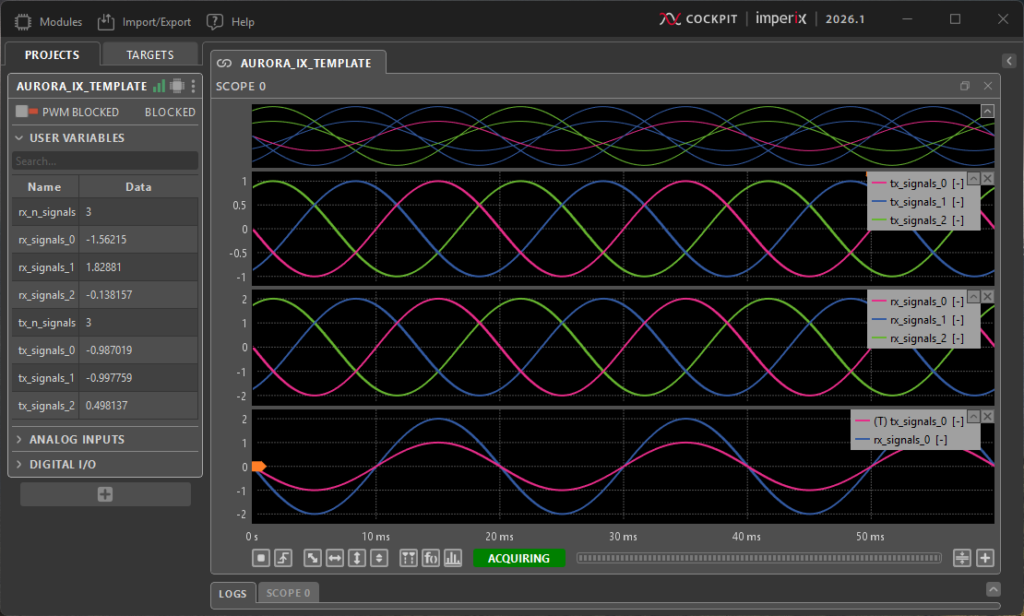
The exchanged signals can also be monitored from Typhoon HIL SCADA, as described in the Typhoon HIL application section.
To go further
The following technical notes illustrate how SFP-based communication is used to exchange real-time signals between imperix controllers and third-party simulators in Power Hardware-in-the-Loop (P-HIL) testbenches:
 By François Ledent • February 2, 2026 • PN110