Modbus out - Modbus TCP output mailbox

The Modbus_out block transmits data over Ethernet using the Modbus TCP protocol on TCP port 502. The block can be configured to operate in one of two modes:

  • Master/Client: the controller actively sends write requests to a remote Slave/Server device.
  • Slave/Server: the controller updates its own internal registers, making the data available for an external Master/Client device to read.

The block supports the Register types listed below.

Register typeAccessSize
Discrete inputR1 bit (encoded as 1 byte, using the LSB)
Coil (discrete output)R/W1 bit (encoded as 1 byte, using the LSB)
Input registerR 16 bit (2 bytes)
Holding registerR/W16 bit (2 bytes)

A concrete application example is presented in PN203, which runs a Modbus client on a TPI8032 and uses an external master on a computer.

To receive data, use the Modbus_in block instead. Alternatively, for periodic transfers without explicit requests, especially at higher rates or with numerous variables, the Ethernet UDP output mailbox can be used instead.

Parameters

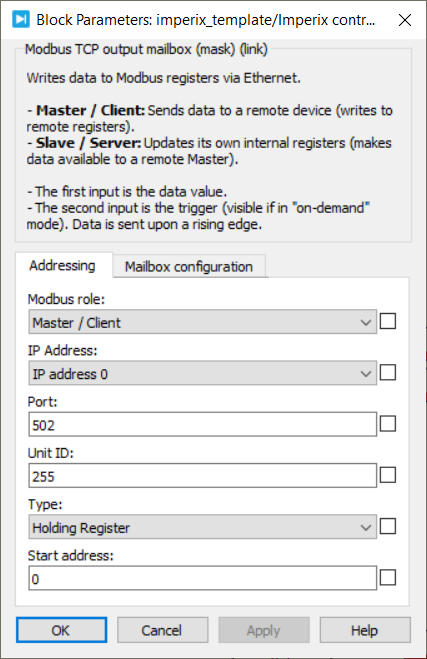
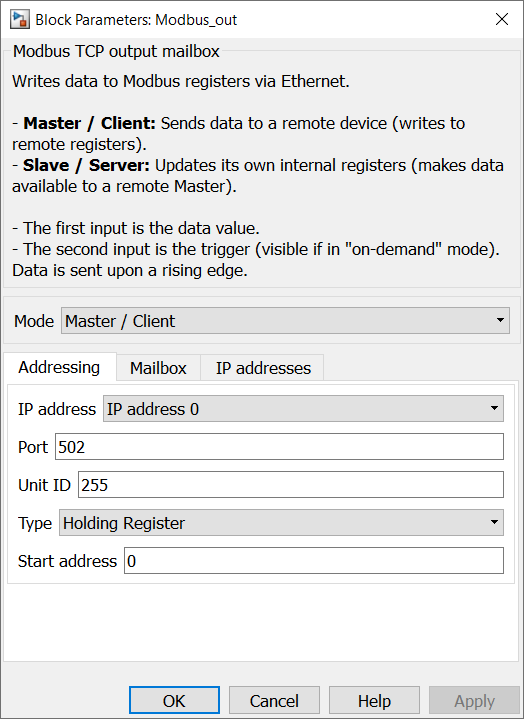
  • Mode: Selects the mailbox’s operating mode (Master/Client or Slave/Server).
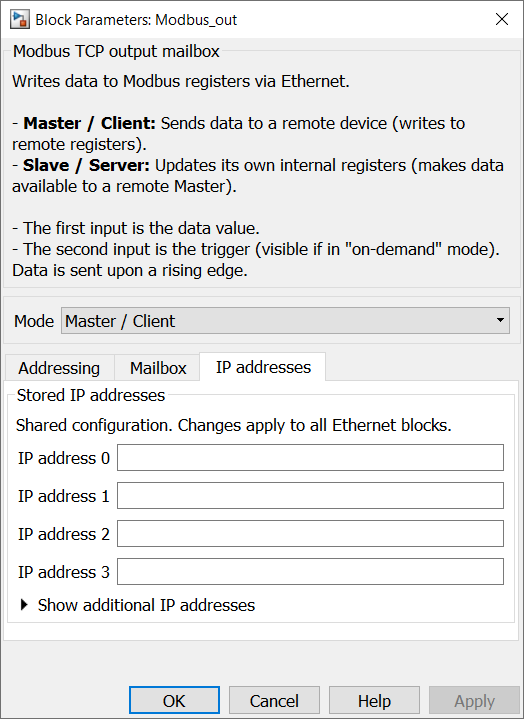
  • IP Address (Master mode only): Selects the IP address to whom the data will be sent.
  • Type: Selects the Modbus register type to write to.
    • Discrete input (Slave mode only)
    • Coil
    • Input register (Slave mode only)
    • Holding register
  • Start address: Sets the starting Modbus address for the range of registers to write (0–65535).
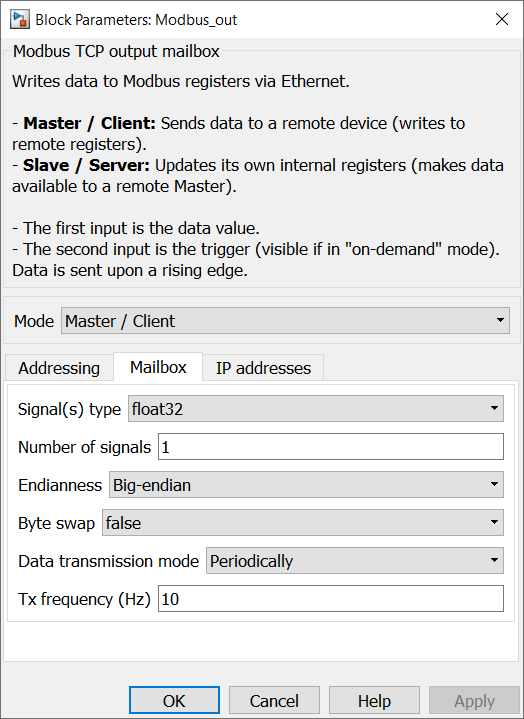
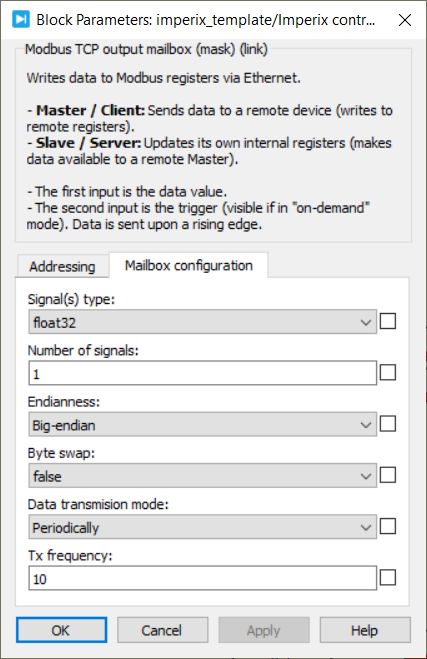
  • Signal(s) type: Defines the data type of the input signal (int8, int16, int32, uint8, uint16, uint32, float32, or float64).
  • Number of signals: Specifies the vector size of the data to be sent. The number of registers physically used is determined by the equivalent vector size in 16-bit words.
  • Data transmission mode: Selects when the controller sends data.
    • On-demand: The user manually triggers each transmission via the trigger input (at the rising edge).
    • Periodically: The controller sends data at a fixed rate, regardless of whether the data has changed.
  • Tx frequency (Hz): Defines the transmission rate in Hz (only relevant in Periodically mode).
  • Endianness (Master mode only): Defines the order of the 16-bit registers used to encode multi-register values.
  • Byte swap (Master mode only): When enabled, swaps the two bytes inside each 16-bit register.

The four combinations of Byte order and swap produce the following byte sequences, where A is the most significant byte of a 32-bit value and D the least significant:

EndiannessByte swapSequence
Big-endianfalseABCD
Big-endiantrueBADC
Little-endiantrueCDAB
Little-endianfalseDCBA

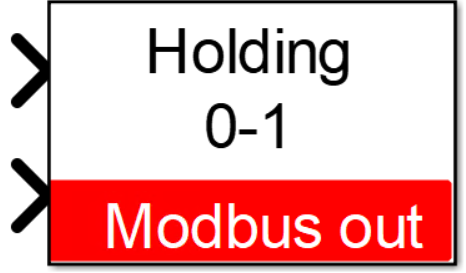
Simulink block

Signal specification

  • The data input accepts a vector containing the data to write via Modbus TCP. Use the Number of signals parameter to set the vector length, and the Signal(s) type parameter to set the input data type.
  • The second input is the trigger (only visible in “on-demand” mode). The block sends data on a rising edge of this signal.
Mask
PLECS block

Signal specification

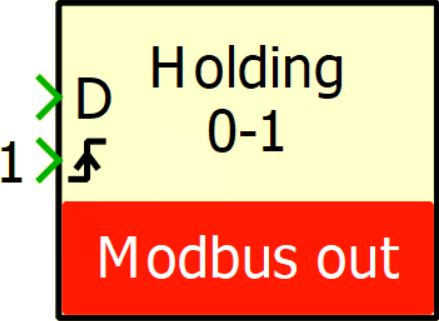
  • The data input (D) accepts a vector containing the data to write via Modbus TCP. Use the Number of signals parameter to set the vector length, and the Signal(s) type parameter to set the input data type.
  • The second input is the trigger (only visible in “on-demand” mode). The block sends data on a rising edge of this signal.

Mask
C++ functions

Master

bool ModbusMaster_ConfigureHoldingRegisterOutputMailbox(unsigned int mailboxId, const char* ip, uint16_t port, unsigned int modbusAddress, unsigned int size, tModbusRegByteOrder regByteOrder, float pollingFrequency);Code language: C++ (cpp)

Configures a Holding Register output mailbox for Modbus Master mode. Once configured, the controller sends the mailbox data to the specified register(s) on the remote Slave device.

Call this function in UserInit().

Parameters

  • mailboxId: a unique ID that distinguishes this mailbox from all others. This ID must be unique throughout the code for all ETH, CAN, and Modbus input/output mailboxes.
  • ip: IP address of the remote Modbus Slave (e.g., "192.168.1.100").
  • port: TCP port of the Modbus Slave (typically 502).
  • modbusAddress: starting Modbus register address on the Slave (0–65535).
  • size: size in bytes of the data to write (must be a multiple of 2, max 246 bytes).
  • regByteOrder: register byte order — either tModbusRegByteOrder::STANDARD or tModbusRegByteOrder::SWAPPED.
  • pollingFrequency: maximum transmission frequency in Hz.

Return value

  • bool: returns false if the configuration fails (e.g., too many mailboxes or invalid parameters).
bool ModbusMaster_ConfigureCoilOutputMailbox(unsigned int mailboxId, const char* ip, uint16_t port, unsigned int modbusAddress, unsigned int size, float pollingFrequency);Code language: C++ (cpp)

Configures a Coil output mailbox for Modbus Master mode. Once configured, the controller sends the mailbox coil values to the remote Slave device.

Call this function in UserInit().

Parameters

  • mailboxId: a unique ID that distinguishes this mailbox from all others. This ID must be unique throughout the code for all ETH, CAN, and Modbus input/output mailboxes.
  • ip: IP address of the remote Modbus Slave (e.g., "192.168.1.100").
  • port: TCP port of the Modbus Slave (typically 502).
  • modbusAddress: starting Modbus coil address on the Slave (0–65535).
  • size: number of coils to write.
  • pollingFrequency: maximum transmission frequency in Hz.

Return value

  • bool: returns false if the configuration fails.
bool ModbusMaster_WriteHoldingRegister(unsigned int mailboxId, const void* data, unsigned int size);Code language: C++ (cpp)

Writes data to a Holding Register output mailbox for transmission to the remote Slave.

Call this function during the control interrupt.

Parameters

  • mailboxId: unique mailbox identifier.
  • data: pointer to the data to write.
  • size: size in bytes (must match the configured mailbox size).

Return value

  • bool: returns true if the data was successfully queued for transmission.
bool ModbusMaster_WriteCoil(unsigned int mailboxId, const uint8_t* data, unsigned int size);Code language: C++ (cpp)

Writes data to a Coil output mailbox for transmission to the remote Slave. Each byte in the input array represents one coil value.

Call this function during the control interrupt.

Parameters

  • mailboxId: unique mailbox identifier.
  • data: pointer to the coil data array.
  • size: number of coils (must match the configured mailbox size).

Return value

  • bool: returns true if the data was successfully queued for transmission.
bool ModbusMaster_ConfigureRegisterMailboxEndianness(unsigned int mailboxId, tEndianness endianness, unsigned int bytesPerValue);Code language: C++ (cpp)

Configures how a Modbus Master holding-register or input-register mailbox interprets multi-register values. By default, register mailboxes are interpreted as independent 16-bit registers (bytesPerValue = 2, endianness = BIG_ENDIAN). The endianness parameter only affects values spanning more than one 16-bit register, so it has no effect when bytesPerValue is 1 or 2.

Call this function in UserInit().

Parameters

  • mailboxId: unique mailbox identifier.
  • endianness: register order inside each logical value (LITTLE_ENDIAN = low word first, BIG_ENDIAN = high word first).
  • bytesPerValue: size in bytes of one interpreted value (must be 1, or an even number ≥ 2, and divide the mailbox size).

Return value

  • bool: returns false if the mailbox does not exist, is not a master holding-register or input-register mailbox, or if the size is invalid. Otherwise, returns true.

Slave

bool ModbusSlave_ConfigureHoldingRegisterOutputMailbox(unsigned int mailboxId, unsigned int modbusAddress, unsigned int size);Code language: C++ (cpp)

Configures a Holding Register output mailbox for Modbus Slave mode. After configuration, your code writes data to this mailbox, and an external Modbus Master can read it.

Call this function in UserInit().

Parameters

  • mailboxId: a unique ID that distinguishes this mailbox from all others. This ID must be unique throughout the code for all ETH, CAN, and Modbus input/output mailboxes.
  • modbusAddress: starting Modbus register address (0–65535).
  • size: size in bytes (must be a multiple of 2, max 246 bytes).

Return value

  • bool: returns false if the configuration fails.
bool ModbusSlave_ConfigureInputRegisterOutputMailbox(unsigned int mailboxId, unsigned int modbusAddress, unsigned int size);Code language: C++ (cpp)

Configures an Input Register output mailbox for Modbus Slave mode. After configuration, your code writes data to this mailbox, and an external Modbus Master can read it as input registers.

Call this function in UserInit().

Parameters

  • mailboxId: a unique ID that distinguishes this mailbox from all others. This ID must be unique throughout the code for all ETH, CAN, and Modbus input/output mailboxes.
  • modbusAddress: starting Modbus register address (0–65535).
  • size: size in bytes (must be a multiple of 2, max 246 bytes).

Return value

  • bool: returns false if the configuration fails.
bool ModbusSlave_ConfigureCoilOutputMailbox(unsigned int mailboxId, unsigned int modbusAddress, unsigned int size);Code language: C++ (cpp)

Configures a Coil output mailbox for Modbus Slave mode. After configuration, your code writes coil values to this mailbox, and an external Modbus Master can read them.

Call this function in UserInit().

Parameters

  • mailboxId: unique mailbox identifier.
  • modbusAddress: starting Modbus coil address (0–65535).
  • size: number of coils (each coil uses 1 byte in the data array).

Return value

  • bool: returns false if the configuration fails.
bool ModbusSlave_ConfigureDiscreteInputOutputMailbox(unsigned int mailboxId, unsigned int modbusAddress, unsigned int size);Code language: C++ (cpp)

Configures a Discrete Input output mailbox for Modbus Slave mode. After configuration, your code writes discrete input values to this mailbox, and an external Modbus Master can read them.

Call this function in UserInit().

Parameters

  • mailboxId: unique mailbox identifier.
  • modbusAddress: starting Modbus discrete input address (0–65535).
  • size: number of discrete inputs (each uses 1 byte in the data array).

Return value

  • bool: returns false if the configuration fails.
bool ModbusSlave_WriteHoldingRegister(unsigned int mailboxId, const void* data, unsigned int size);Code language: C++ (cpp)

Writes data to a Holding Register output mailbox, making it available for an external Master to read.

Call this function during the control interrupt.

Parameters

  • mailboxId: unique mailbox identifier.
  • data: pointer to the data to write.
  • size: size in bytes (must match the configured mailbox size).

Return value

bool: returns true if the data was successfully written.

bool ModbusSlave_WriteInputRegister(unsigned int mailboxId, const void* data, unsigned int size);Code language: C++ (cpp)

Writes data to an Input Register output mailbox, making it available for an external Master to read.

Call this function during the control interrupt.

Parameters

  • mailboxId: unique mailbox identifier.
  • data: pointer to the data to write.
  • size: size in bytes (must match the configured mailbox size).

Return value

bool: returns true if the data was successfully written.

bool ModbusSlave_WriteCoil(unsigned int mailboxId, const uint8_t* data, unsigned int size);Code language: C++ (cpp)

Writes data to a Coil output mailbox, making it available for an external Master to read. Each byte in the input array represents one coil value.

Call this function during the control interrupt.

Parameters

  • mailboxId: unique mailbox identifier.
  • data: pointer to the coil data array.
  • size: number of coils (must match the configured mailbox size).

Return value

bool: returns true if the data was successfully written.

bool ModbusSlave_WriteDiscreteInput(unsigned int mailboxId, const uint8_t* data, unsigned int size);Code language: C++ (cpp)

Writes data to a Discrete Input output mailbox, making it available for an external Master to read. Each byte in the input array represents one discrete input value.

Call this function during the control interrupt.

Parameters

  • mailboxId: unique mailbox identifier.
  • data: pointer to the discrete input data array.
  • size: number of discrete inputs (must match the configured mailbox size).

Return value

bool: returns true if the data was successfully written.